
Sugar Defender Review: A Transparent, Evidence-Aware Breakdown
Blood-sugar support supplements are everywhere — and the marketing often sounds more confident than the science.
This Sugar Defender Review takes a neutral, evidence-aware approach: what the product page says, what research suggests about the listed ingredients, and what we can’t conclude without product-specific clinical trials.
- What Is Sugar Defender?
- How It Works: plausible pathways (and where it gets uncertain)
- Evidence Strength Overview
- Ingredient Breakdown (what it is, what research suggests, limitations, safety notes)
- Potential Benefits (realistic, qualified)
- Side Effects & Safety
- Pros and Cons
- Realistic Expectations
- Who Is It For / Who Should Avoid
- Final Verdict
- FAQ
- References
- Disclaimer
What Is Sugar Defender?
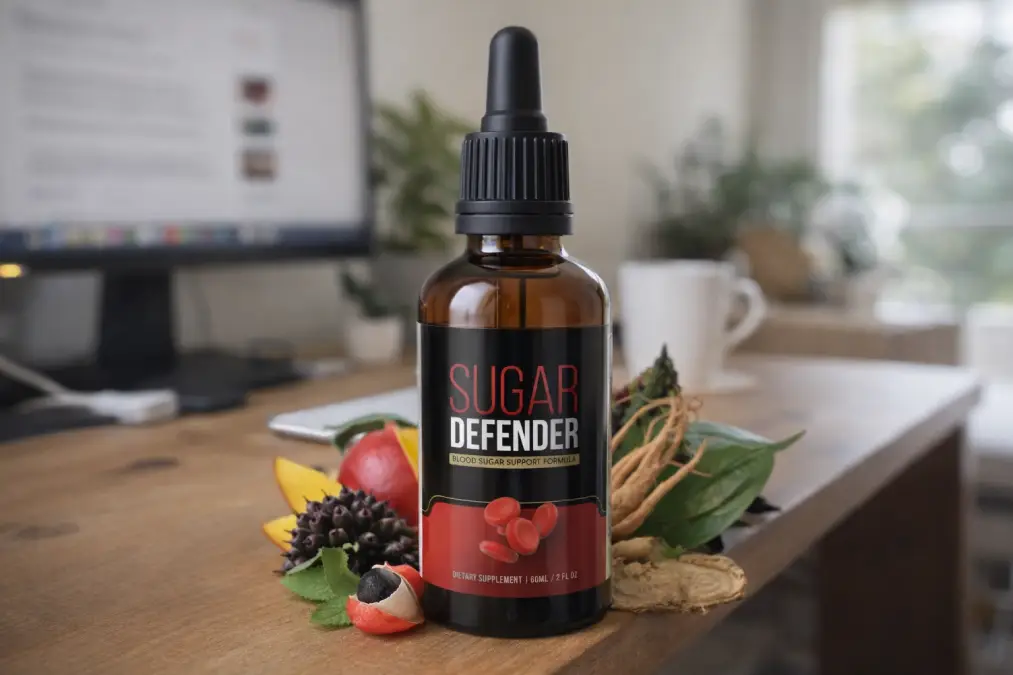
Sugar Defender is a liquid “dropper” supplement marketed for healthy blood sugar support and related outcomes like energy and appetite control. The manufacturer describes it as a plant-ingredient formula with added minerals, sold in multi-bottle packages and backed by a 60-day money-back guarantee.
How it’s taken (per product page): two full droppers under the tongue in the morning before breakfast, holding for ~30 seconds before swallowing; alternatively, mix droppers into water.
What’s notably missing on the order page: a visible Supplement Facts panel with exact dosages for each ingredient. That matters because dose and standardization are a big part of whether an ingredient’s study results are even relevant.
How It Works: plausible pathways (and where it gets uncertain)
Sugar Defender’s concept is straightforward: combine botanicals/minerals commonly discussed in metabolism research to potentially support:
- Glucose handling / insulin signaling (often discussed with minerals like chromium and with some herbs)
- Appetite / cravings (some botanicals may influence taste or appetite signals)
- Energy and alertness (stimulant-containing ingredients like guarana can change perceived energy)
These pathways are plausible in theory, but plausibility is not proof—especially when the exact ingredient doses, extract types, and quality controls are not clearly shown on the order page.
Evidence Strength Overview
- Ingredient-Level Evidence: Mixed (Low → Moderate depending on ingredient).
- Finished Product Clinical Trials: Not publicly available (no product-specific RCTs found on the order page).
- Mechanistic Plausibility: Moderate (reasonable hypotheses, but not validated as a combined formula).
- Safety Profile: Unclear at product level; ingredient-level cautions apply.
* Safety comments are based on ingredient research and general guidance, not on trials of the finished Sugar Defender formula.
Ingredient Breakdown (what it is, what research suggests, limitations, safety notes)
The order page lists 8 ingredients: Eleuthero, Coleus, Maca Root, African Mango, Guarana, Gymnema, Ginseng, Chromium.
1) Eleuthero (Eleutherococcus senticosus)
- What it is: An herb sometimes called “eleuthero” (not true ginseng).
- What research suggests: Traditionally used for fatigue/“asthenia.” EMA documents recognize use for tiredness/weakness based on long-standing use (not the same as strong modern trial proof).
- Limitations: Evidence for blood sugar effects in humans is not definitive; product dose/extract type matters.
- Safety notes: Herbal products can interact with conditions/meds; caution if you have cardiovascular issues or are sensitive to stimulants (especially if combined with guarana).
2) Coleus (typically Coleus forskohlii / forskolin)
- What it is: A plant source of forskolin, often marketed for body composition.
- What research suggests: Some RCTs exist for weight/body composition markers, but the literature is limited and results are not uniformly strong.
- Limitations: Small trials, varying extracts/doses; not specific to Sugar Defender’s formula.
- Safety notes: May affect blood pressure and interact with certain meds (especially for blood pressure or blood-thinning)—best discussed with a clinician if you’re medicated.
3) Maca Root (Lepidium meyenii)
- What it is: A root traditionally used for vitality/wellbeing.
- What research suggests: Research is broader than blood sugar — often focusing on wellbeing, fatigue, and other endpoints; metabolic claims are not well-established in robust clinical trials.
- Limitations: Many studies are not designed around glucose outcomes; standardization varies.
- Safety notes: Generally considered well-tolerated in common use, but evidence for long-term, high-dose supplementation is limited.
4) African Mango (Irvingia gabonensis)
- What it is: Seed extract marketed for weight management.
- What research suggests: A systematic review reported positive signals for weight/waist outcomes, but also concluded evidence is limited by small number of trials and poor reporting quality—so it can’t be confidently recommended as a weight-loss aid.
- Limitations: The “quality of evidence” problem is the main issue here.
- Safety notes: Reported adverse events in studies include things like headache/sleep issues; product-specific risk is unknown.
5) Guarana (Paullinia cupana)
- What it is: A caffeine-rich botanical.
- What research suggests: Most reliable effects relate to stimulation/alertness (largely attributable to caffeine). Reviews discuss cognitive/alertness outcomes with mixed results depending on study design and dosing.
- Limitations: If the product doesn’t disclose caffeine content, it’s hard to judge real-world impact and tolerability.
- Safety notes: Watch total caffeine intake; general guidance for adults often cites ~400 mg/day as an upper “generally safe” level, but individual sensitivity varies.
If you’re caffeine-sensitive, prone to anxiety/insomnia, or have heart rhythm concerns, guarana-containing supplements may be a poor fit.
6) Gymnema sylvestre
- What it is: An herb studied for glycemic markers.
- What research suggests: A 2021 systematic review/meta-analysis found Gymnema supplementation was associated with improvements in fasting glucose, post-meal glucose, and HbA1c across included studies.
- Limitations: Heterogeneity is high in this area—different extracts, doses, durations, and participant populations.
- Safety notes: Because it may influence glucose, combining with diabetes medications could increase hypoglycemia risk—this is a “talk to your clinician first” category.
7) Ginseng (Panax genus)
- What it is: “True” ginseng species; typically Panax ginseng in supplements.
- What research suggests: Meta-analyses show modest improvements in fasting blood glucose, with uncertainty and variability across trials; authors often call for larger, longer RCTs with standardized products.
- Limitations: Effects are generally not dramatic; not consistent across all outcomes.
- Safety notes: Can interact with certain meds and conditions; also may be stimulating for some people.
8) Chromium
- What it is: A trace mineral involved in insulin-related pathways; supplement forms vary.
- What research suggests: Meta-analyses in type 2 diabetes show mixed outcomes—some report improvements in certain markers, but results vary by chromium form, baseline status, and study design.
NIH ODS notes chromium’s proposed role in potentiating insulin action, while also highlighting ongoing scientific debate and variability in evidence. - Limitations: Not all chromium forms behave the same; without dose/form disclosed for Sugar Defender, applicability is uncertain.
- Safety notes: NCCIH notes side effects can occur with some supplements used for diabetes; for chromium specifically, reports include GI upset and rare serious issues at high doses.
Potential Benefits (realistic, qualified)
Based on the ingredient list and the broader research landscape, Sugar Defender may:
- Support some blood sugar markers in some users (ingredient-level signals exist for Gymnema, chromium, and ginseng)
- Increase perceived energy/alertness (likely driven by guarana/caffeine)
- Support weight-related goals indirectly via appetite/energy effects (but evidence for African mango and coleus is not strong enough to treat as reliable)
Important: Ingredient evidence does not validate the finished product, especially without disclosed dosages and without product-specific trials.
Side Effects & Safety
Key safety realities for blood-sugar supplements:
- Don’t replace medical care. NCCIH warns against diabetes products that sound “too good to be true,” and emphasizes not replacing effective diabetes treatment with unproven supplements.
- Medication interactions are the big concern. If you take insulin or glucose-lowering meds, adding ingredients that may affect glucose (Gymnema, chromium, ginseng) could increase hypoglycemia risk—this requires clinician oversight.
- Stimulant tolerance varies. Guarana adds caffeine exposure; if caffeine content isn’t disclosed, it’s hard to assess risk for sleep, anxiety, or palpitations.
Pros and Cons
Pros
- Ingredient list includes several compounds with some research interest for glycemic markers (Gymnema, chromium, ginseng).
- Clear directions for use and a stated 60-day money-back guarantee.
Cons
- No publicly clear Supplement Facts dosing on the order page → hard to judge effectiveness or safety with confidence.
- No product-specific clinical trials presented/accessible for validation.
- Includes a stimulant botanical (guarana), which can be a deal-breaker for some.
If you’d like to better understand how supplements like Sugar Defender are designed to support blood sugar balance — including mechanisms related to glucose absorption, insulin sensitivity, and cravings — we break these concepts down in a separate educational article that explains the science behind commonly used botanical compounds, without marketing claims or hype.
Realistic Expectations
If you try Sugar Defender, the most realistic expectation is subtle change—if any—over weeks to months, not a dramatic transformation. Even meta-analyses for some individual ingredients describe modest effects and significant variability.
Lifestyle fundamentals (diet pattern, fiber intake, sleep, resistance training, stress) usually have a larger and more reliable impact on glucose regulation than any single supplement.
Who Is It For / Who Should Avoid
May be a fit for:
- Adults 35+ who want a non-prescription “support” approach alongside lifestyle changes (not instead of them)
- People who tolerate caffeine well (if guarana content is not a concern)
Should avoid or get medical clearance first:
- Anyone on glucose-lowering medications (insulin, metformin, sulfonylureas, etc.)
- People with heart rhythm issues, uncontrolled high blood pressure, severe anxiety/insomnia (due to stimulant exposure)
- Pregnant/breastfeeding individuals (general supplement precaution unless cleared by clinician)
Final Verdict
Sugar Defender is not automatically “good” or “bad”—it’s uncertain. The ingredient list includes a few compounds with some supportive research signals, but the biggest credibility gaps are:
- No product-specific clinical trial evidence, and
- No clear dosing/standardization shown on the order page, which makes it impossible to map research to the actual formula.
If you’re generally healthy and simply looking for a “support” supplement, you could consider it as a trial — but only with realistic expectations and with extra caution if you’re on medications or sensitive to stimulants.
If you want to check the official offer details directly, here’s the link
FAQ
Does Sugar Defender have clinical studies on the finished product?
No product-specific randomized controlled trials were found on the order page.
What are the ingredients in Sugar Defender?
The order page lists: Eleuthero, Coleus, Maca Root, African Mango, Guarana, Gymnema, Ginseng, and Chromium.
How do you take Sugar Defender drops?
The product page instructs: two full droppers in the morning before breakfast (under the tongue ~30 seconds), or mixed into water.
Can Sugar Defender replace diabetes medication?
No. NCCIH explicitly warns against replacing effective diabetes treatment with unproven supplements.
Is Gymnema actually supported by research?
A 2021 systematic review/meta-analysis reported improvements in fasting glucose, post-meal glucose, and HbA1c across included studies, but results vary and depend on extract/dose.
Does guarana mean Sugar Defender contains caffeine?
Guarana is naturally caffeine-rich. Without disclosed caffeine amounts, it’s difficult to assess stimulation and tolerance.
References
- NCCIH — Diabetes and Dietary Supplements: What You Need to Know
- PubMed — Gymnema sylvestre supplementation and glycemic control (systematic review & meta-analysis)
- PubMed — Effects of ginseng on fasting blood glucose (systematic review & meta-analysis)
- NIH Office of Dietary Supplements — Chromium: Fact Sheet for Health Professionals
- PubMed — Irvingia gabonensis (African mango): systematic review
- Sugar Defender — Official Product Page (manufacturer information)
Disclaimer
This article is for informational purposes only and does not constitute medical advice. Consult a healthcare professional before starting any supplement. Some links may be affiliate links.