
How Botanical Compounds May Support Blood Sugar Balance: Mechanisms Explained
- Introduction: Why Blood Sugar Balance Is More Than a Number
- How Blood Sugar Is Regulated in the Body (High-Level Overview)
- Where Botanical Compounds Fit Into Blood Sugar Support
- Key Mechanisms Studied in Botanical Blood Sugar Support
- Why Results Vary So Much Between Individuals
- What These Mechanisms Can — and Cannot — Do
- How These Mechanisms Are Reflected in Modern Supplement Formulas
- How to Read Blood Sugar Supplements More Critically
- Final Thoughts: Education Before Decisions
Introduction: Why Blood Sugar Balance Is More Than a Number
When people talk about blood sugar, the conversation often focuses on a single value — fasting glucose or a lab result. In reality, blood sugar balance is a dynamic process influenced by digestion, hormonal signaling, energy demand, stress, and behavior throughout the day.
From a metabolic perspective, blood sugar support is not about forcing glucose levels down. Instead, it refers to supporting the body’s natural ability to manage glucose efficiently after meals, respond appropriately to insulin, and return to baseline without excessive spikes or crashes.
This distinction matters because many nutritional and botanical compounds are studied not as treatments, but as supportive tools that may influence specific steps within these processes. Understanding how these mechanisms work helps set realistic expectations — and reduces confusion created by oversimplified claims.
How Blood Sugar Is Regulated in the Body (High-Level Overview)
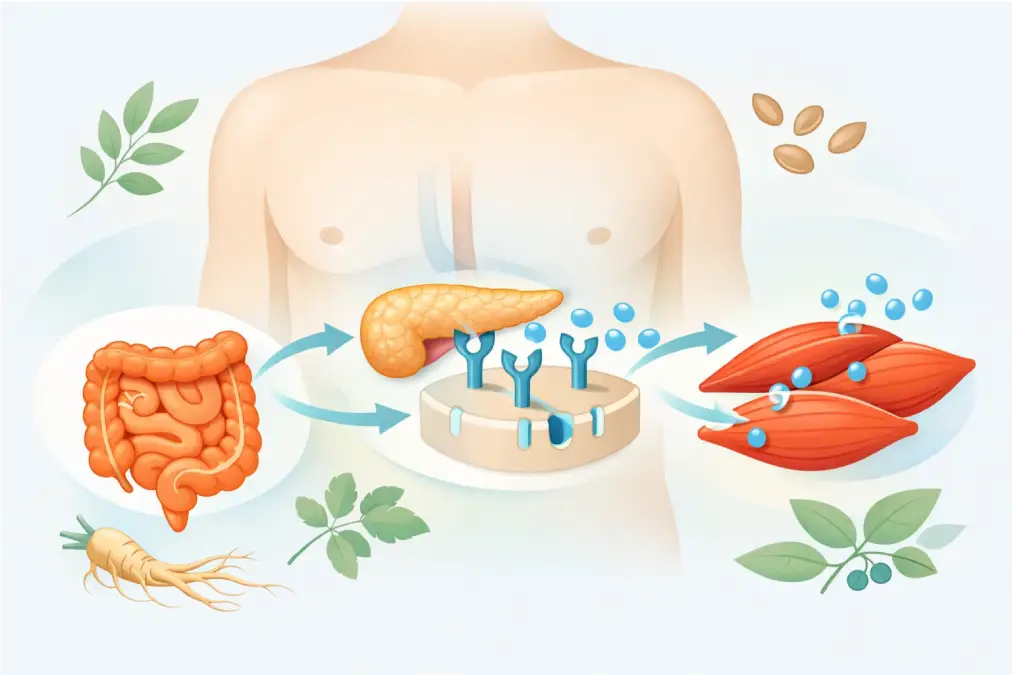
After consuming carbohydrates, they are broken down into glucose, which enters the bloodstream. This rise in blood glucose triggers the pancreas to release insulin, a hormone that helps move glucose from the blood into muscle, liver, and fat cells where it can be used or stored.
Several interconnected systems are involved in this regulation:
- Digestive enzymes that determine how quickly carbohydrates are broken down
- Insulin signaling pathways that control glucose uptake into cells
- Glucose transporters (such as GLUT proteins) that move glucose across cell membranes
- Liver regulation, which determines how much glucose is released or stored
Short-term increases in blood sugar after meals are normal. Problems arise when spikes are frequent, exaggerated, or followed by sharp drops, which may affect energy levels, hunger, and metabolic stress over time.
If you want a deeper explanation of what commonly causes blood sugar spikes — including diet, meal timing, and lifestyle factors — we cover this in a separate guide.
Where Botanical Compounds Fit Into Blood Sugar Support
Botanical compounds are not medications, and they are not designed to override physiology. Instead, they are studied for how they may interact with existing metabolic pathways.
Research on plant-derived compounds typically explores questions such as:
- Can a compound modulate glucose absorption in the gut?
- Can it support insulin signaling or glucose transport?
- Can it influence appetite, cravings, or perceived energy in ways that indirectly affect glucose balance?
These effects are usually context-dependent, meaning outcomes vary based on dose, formulation, diet, and individual metabolic status. This is why blood sugar support through botanicals is best understood as adjunctive, not corrective.
Key Mechanisms Studied in Botanical Blood Sugar Support
Glucose Absorption and Carbohydrate Metabolism
One area of research focuses on the digestive phase of carbohydrate metabolism. Certain botanical compounds have been studied for their potential to influence enzymes involved in breaking down carbohydrates in the gut.
By slowing or modulating this process, glucose may enter the bloodstream more gradually, potentially reducing the magnitude of post-meal spikes. However, this mechanism does not eliminate glucose absorption — it only affects timing and rate, and its real-world impact depends heavily on meal composition.
Insulin Sensitivity and Cellular Glucose Uptake
Another major focus of blood sugar support research involves insulin sensitivity — how effectively cells respond to insulin’s signal to absorb glucose.
Some minerals and plant-derived compounds are studied for their role in insulin-related pathways at the cellular level. Supporting insulin sensitivity does not mean “fixing” insulin resistance, but rather helping existing signaling pathways function more efficiently under certain conditions.
Importantly, these effects tend to be modest and are most relevant when combined with broader lifestyle factors such as physical activity and dietary patterns.
Taste Perception, Cravings, and Appetite Signals
Blood sugar balance is influenced not only by physiology, but also by behavior. Taste perception, especially sensitivity to sweetness, plays a role in food choices and cravings.
Some botanical compounds are studied for how they may affect sweet taste receptors or appetite-related signals. By altering how sweetness is perceived or how cravings are experienced, these compounds may indirectly support blood sugar balance through changes in eating behavior rather than direct metabolic action.
Energy Levels, Stress, and Metabolic Load
Stress hormones and perceived energy levels can also influence glucose regulation. Acute stress may increase glucose release from the liver, while chronic stress can affect insulin signaling over time.
Certain botanical ingredients are researched for their effects on alertness, fatigue, or stress response. While these effects are not directly glucose-lowering, they may influence daily behaviors — such as meal timing, food choices, or activity levels — that shape overall blood sugar patterns.
Why Results Vary So Much Between Individuals
One of the most consistent findings in nutrition research is variability. Responses to blood sugar support strategies differ widely due to factors such as:
- Baseline diet and carbohydrate intake
- Gut microbiota composition
- Age and metabolic health
- Physical activity and muscle mass
- Sleep quality and stress levels
This variability explains why some studies show benefits while others report minimal effects. It also explains why individuals may report different experiences with the same approach. Variability is not a flaw in the science — it is a reflection of human biology..
What These Mechanisms Can — and Cannot — Do
What they may do
- Support more gradual post-meal glucose responses
- Complement lifestyle-based blood sugar strategies
- Help individuals better understand their metabolic responses
What they cannot do
- Replace medical treatment for metabolic disorders
- Guarantee blood sugar control
- Override poor dietary or lifestyle habits
Recognizing these limits is essential for responsible interpretation of blood sugar support research.
How These Mechanisms Are Reflected in Modern Supplement Formulas
Many modern blood sugar support supplements are formulated to address multiple mechanisms simultaneously, combining botanical compounds and minerals that target digestion, insulin signaling, appetite, or energy balance.
Some products, such as Sugar Defender, are designed around these commonly discussed mechanisms. However, understanding the mechanisms themselves is more important than focusing on any single formula, especially when product-specific clinical trials are limited or unavailable.
If you’re interested in seeing how these commonly discussed mechanisms are combined in a real-world supplement formula, we reviewed Sugar Defender in detail, with a transparent breakdown of ingredients, evidence, and limitations.
How to Read Blood Sugar Supplements More Critically
An informed reader should approach blood sugar support supplements with the following questions:
- Are the mechanisms explained, or only the outcomes promised?
- Are ingredient doses and forms clearly disclosed?
- Are claims attributed to research, or presented as conclusions?
- Are limitations acknowledged?
Distinguishing biological plausibility from proven effect helps reduce unrealistic expectations and improves decision-making.
Final Thoughts: Education Before Decisions
Blood sugar support is a nuanced topic that sits at the intersection of physiology, behavior, and nutrition. Botanical compounds may play a supportive role within this system, but they work best when understood as part of a broader metabolic context.
By focusing on mechanisms rather than promises, readers can better evaluate supplements, interpret research, and make decisions grounded in understanding rather than hype.
qvolywjlwjynsijdovnofrkthyyndm
ndxiqewxzwztiutyrfowjvtqldgxvy
hprkfkfqgwkpvkpufkixtmjnveelho